Monday, 26 November 2012

TASMANIA 3 - THE NORTH-EAST

From Launceston we drove north-east to a fantastic campground called Myrtle Park. The park is about 30 klms southwest of Scottsdale and is only $3 per night for a site. There are no powered sites but there is heaps of room with many camps right beside St Patrick’s River. The toilet block was excellent with beautiful hot showers and most sites also had picnic tables and fireplaces. This would be an excellent base for exploring the northeast. There is even a tennis court and we were assured there were also trout in the creek. We would have stayed longer but we had visited the lavender farm etc on our last trip so we only stayed for the one night.

Next morning we headed to Bridport and then continued northeast to Waterhouse Conservation Area. There are lots of camping areas including two lagoons on the way which were very ordinary. We later learned that these camps were used by duck shooters, which explained why they were not maintained at all. Anyway we continued on to Waterhouse Point. Most of the camps in this area are on the eastern side of the Point and this is definitely the better side especially if there is a westerly blowing. However, when we arrived, all of the camps on the eastern side were full so we went into The Village Green on the western side. The campground was excellent, with plenty of room and grassy sites amongst the coastal heath and the beach was fantastic. The views from the van across to Waterhouse Island were beautiful.
Looking across to Waterhouse Isand.

The beach was beautiful.

 
We didn’t have mobile coverage at the camp but there is coverage on the eastern side of the Point. Imagine how stoked we were too when we discovered abalone on the rocks at low tide. It was abalone patties for dinner and they are delicious. Thank goodness I bought a good blender before we left. There were also fish to be caught off the Point as well. We were given a lovely big salmon by a lovely young lad from Launceston. If we have time at the end of our trip this is one place we would definitely like to revisit.


There's abalone in them thar rocks!
This bright little resident attracted my attention.
Ransoms Beach on the eastern side of the Point is the nicest spot if you can get a site. It can be crowded.
After three nights at Waterhouse Point we drove down to Gladstone, a little hamlet south of Cape Portland at the very northeast tip of the island. We were lucky enough to find water at the little park in the middle of town so we topped up the tanks and then drove north to Petal Point in the Ringarooma Coastal Reserve. The campsite here at Petal Point was very similar to The Village Green but without the abalone and fishing, although I must admit, we probably didn’t get the chance to do too much here with 30 knot winds blowing from the west. We did however take a drive up to the tip past a massive wind farm which is being built right on the Cape. They certainly picked a great place to put one.

Petal Point camping site.

The beach at Petal Point.
It was the wind which decided for us that we should move on the next morning. We drove in to Musselroe Bay, thinking that it might be nicer as it was on the eastern side of the Cape but we were very disappointed. The beach was pretty but we were surprised to find that Musselroe Bay is actually a little community of mainly holiday huts and the camping sites were very ordinary so we opted to keep moving south to Policemans Point on the southern side of Ansons Bay.
There are lots of lovely little camps here either right beside the inlet or there is a really big grassy area nestled in the bush behind the foreshore. We opted for the latter when we arrived but moved over to another site right beside the bay the next morning when we had had a chance to look around properly. Policemans Point is a fantastic place. You have the choice of exploring the sheltered Bay in the tinny or you can wander along the beach around the Point and watch the birds on the sand spit where the bay runs into the sea. At low tide we saw lots of fishermen landing on a sandbar in the middle of the bay and discovered from our neighbouring campers that night that they were collecting cockles, which the guys just cooked up in a pot of sea water on fire. They were delicious just as they were and would be lovely with a nice sauce as well. Unfortunately our efforts to catch a bream were thwarted by the thick beds of weed. I doubt any fish could have seen a bait through it all. We were also lucky enough to sight a rather large seal on the sand spit one afternoon as well. The walks along the beach were a bit smelly as the strong winds had washed up a lot of bull kelp at the point but it was still lovely and the birds were certainly attracted by the kelp piled up on the beach.

The beach just inside the passage at Policemans Point. The sandspit on the left extends right across the northern side of the inlet and is a favourite haunt of lots of seabirds.


Our beachside camp at Policemans Point.

 
From Policemans Point we moved to the southern end of the Bay of Fires. Everyone we had met raved about this area and we can confirm that it is truly breathtaking. There are a number of campsites to choose from north of St Helens so after stocking up we headed out along the Binalong Bay Road then north along the coast a beautiful coastline, dotted with sheltered little bays with crystal clear water and picturesque rock formations. Apparently the area got its name when early explorers saw the fires of aboriginal camps from sea. They would probably give it the same name today as every camp site has several camps in it. We decided that Cosy Corner North was the pick of them for us and settled in for a few days. As always we met some lovely fellow campers including a friendly little pademelon (the smallest of the wallaby family) with her baby who visited our camp regularly. It was hard not to take photos constantly in this area so I’ll let them do the rest of the talking.


Rocks on the beach at Cosy Corner North. 
The Gardens, Bay of Fires
 
As I was driving back into St Helens to do the laundry, I noticed what looked like huge oysters along the shores of Georges Bay so we decided to investigate on our way out. Boy were we stoked to find an abundance of pacific oysters (or feral oysters as they are known locally) just waiting there on the rocks for us to pick. Some of them were huge and it took no time to fill a largish plastic container. Of course it was oysters Kilpatrick that night and mornay the next. We also froze some for carpet bag steaks – one of our favourites. Unbeknownst to us, there are not bag limits on feral oysters so we were kicking ourselves that we hadn’t got more, especially when we saw them growing right around the bay as we drove south.

A small sample of Pacific (feral) oysters. The one top right was the size of a fried egg and that was not unusual.
Just inland from Scamander is Trout Creek, a popular spot for bream fishing with the locals so we decided that it might be worth a look.
The service station in Scamander must have a very artistic owner. I thought these scrap metal sculptures were great.


When we arrived at Trout Creek there was a group oldies from the local nursing home out on a picnic and several of the old guys were fishing from the little jetty. They didn’t catch a lot but they seemed to be enjoying themselves. We unloaded the tinny that afternoon and headed out first thing next morning to see what we could catch. The creek itself runs into the Scamander River not far downstream and although we only caught one bream which we put back as he was only just size, we really enjoyed the serenity of the area especially as it turned out to be another lovey sunny day. We only caught one other bream here but we didn’t mind as it was a lovely spot and the birdlife was amazing. I could have spent hours looking as there were so many different species in the bush. There was even a pair of friendly pacific gulls who eagerly awaited any bits of bait that we might discard.

Trout Creek


Friday, 16 November 2012

TASMANIA 2 - TAMAR VALLEY

We had been told that the town of Deloraine is very pretty and indeed it is with brilliant views across green fields to the mountains beyond. It seems to be a very arty town and is really clean and tidy but as we are more interested in the countryside we continued east to Westbury then north to Exeter so we could check out the camps along the western side of the Tamar Inlet. However, they were all fairly ordinary so we continued up to Batman Bridge as we had heard that there was a nice free camp on the eastern side of the bridge.

Batman Bridge - the bridge itself is very impressive.
It was a nice area but would probably be a bit noisy and there were quite a few other camps (and a family who were obviously living there) so we went back across and headed to Beaconsfield, thinking the showgrounds there might be the go as they are close to Beauty Point where Mitch is. On the way John got very excited when he spotted huge oysters on the rocks beside the road so of course we stopped and picked some. I was a bit suspicious though as to why nobody else had taken them. When John checked on the Net he discovered that they had very high levels of copper and cadmium and were not safe to eat. Bugger!!

Unfortunately, the showgrounds were very ordinary so we continued north to our last hope, the caravan park at Greens Beach. There are other van parks but they either don’t take dogs or are expensive. Greens Beach however was great. The park is right behind the sand dunes and about 50 metres from the beach and at $20 a night for power it was reasonably priced.

There are heaps of echidnas down in Tassie - the thorns look shorter but it is because of their long furry coats. Too cute!!!
As well as visiting Mitch, we took a drive up to West Head lookout and also spent a lovely day exploring the eastern side of the inlet up to Low Head. The Maritime Museum there is great and a real surprise and the walk up to the lighthouse further on was interesting as well. We also dropped in at the mining museum at Beaconsfield which is also very impressive and well worth a visit.
West Head from the Lookout - Narawntapu National Park.


The view from the lookout at West Head looking toward Badger Head in Narawntapu National Park.

 
Beaconsfield Museum

 
An EH Holden club were also visiting the Museum. I thought they looked familiar. My first car was an EH.
Low Head Maritime Museum - You can stay in the cottages here!


Some of these knots were amazing!

Low Head lighthouse


Looking across the head of the inlet from Low Head to Greens Beach

Before leaving the area we called in at the Diving Academy to see what Mitch has been learning. It was a real surprise to us just how professional the whole setup is and also how intense and demanding the training is. The people there made us feel very welcome and it was really interesting looking at all the equipment. John even tried on one of the diving helmets. I opted out. I think it would be really claustrophobic.
 

Mitch at the Academy

Cables used by the divers.
Our only stop in Launceston was Cataract Gorge and it was lovely. The whole complex is very picturesque and there are lots of different options for walks with long, short, easy and demanding treks available. Or if you don’t want to walk at all you can take the chairlift. We opted to walk and went over the suspension bridge to the lovely gardens on the other side then back across. It would be a lovely place to spend a whole day with a picnic etc. but we decided to get through the traffic, which was a challenge in the van as we inadvertently took the route right through the middle of the city which wouldn’t have been an issue except that there is a mall and several one-way streets so you can’t just go straight through. It is also best not to go via the western entrance during school dropoff times. The streets are narrow and steep and with cars parked each side it is a bit tricky especially if towing a van.

Cataract Gorge - Launceston


Rhododendrons - Cataract Gorge
 
The last place we visited on the Tamar was the Tamar Island Wetlands. There is a 1.5 klm walk through the wetlands past old wrecks out to Tamar Island where there is a lovely picnic area including a gas barbecue. There are lots of waterbirds including black swans, teal and water fowl. The $3 entry fee was well spent and includes a very informative brochure covering various features of the wetlands. After Launceston we headed north-east to have a look at the coastal areas.

Wednesday, 14 November 2012

TASMANIA 1 - THE GREAT WESTERN TIERS

The trip across on the ferry was hassle-free. We wouldn’t recommend the on-board dining though and will take our own picnic on the way back. Of course we were worried about Leo down there on deck 3 all night and I found the movement of the ship difficult to get used to so I didn’t sleep much. The cabin was comfortable enough though.

A low lying fog met us as we arrived.

Cruising into Devonport.
As soon as we got through quarantine we headed south-west as we had decided to do Cradle Mountain first to avoid the Christmas Holiday rush. The whole area is called the Great Western Tiers and encompasses the area from Cradle Mountain National Park east to Prospect Vale. It is indeed great. The countryside is beautiful, with the jagged peaks of the Gog Range as a backdrop to sweeping green hills dotted with sheep and cattle. There are numerous rivers, creeks and lakes in the area with hydro-electric stations on almost every lake.

Gog Range

 
Our first stop was Railton where we found a great little butcher with the best dog bones ever. We also indulged in our first curried scallop pie at the local takeaway. Delicious! Then it was on to Sheffield and another stop at the local fruit and vegie shop (we had to restock as you can’t bring them over from the mainland).  We found a fantastic little camping area on Lake Gairdner near the little hamlet of Moina and once again John tried his hand at catching a trout. Again no luck but he did get some bites this time. And again another John came to our rescue. He caught them but didn’t eat them so we had trout for tea anyway. Yum!

Our camp on Lake Gairdner


Early morning mist over Lake Gairdner.

It was a short drive into Cradle Mountain National Park from Lake Gairdner and we got there nice and early in the morning. The free shuttle buses from the information centre which is outside the park take you into Dove Lake or you can drive in if you wish. We took the bus but could have driven as the car park at Dove Lake was almost empty. It did fill up by lunchtime though so I imagine it would be chockers at holiday time. The park people encourage you to take the buses as you can also hop on and off and do a number of different walks of varying distances along the road into the park.

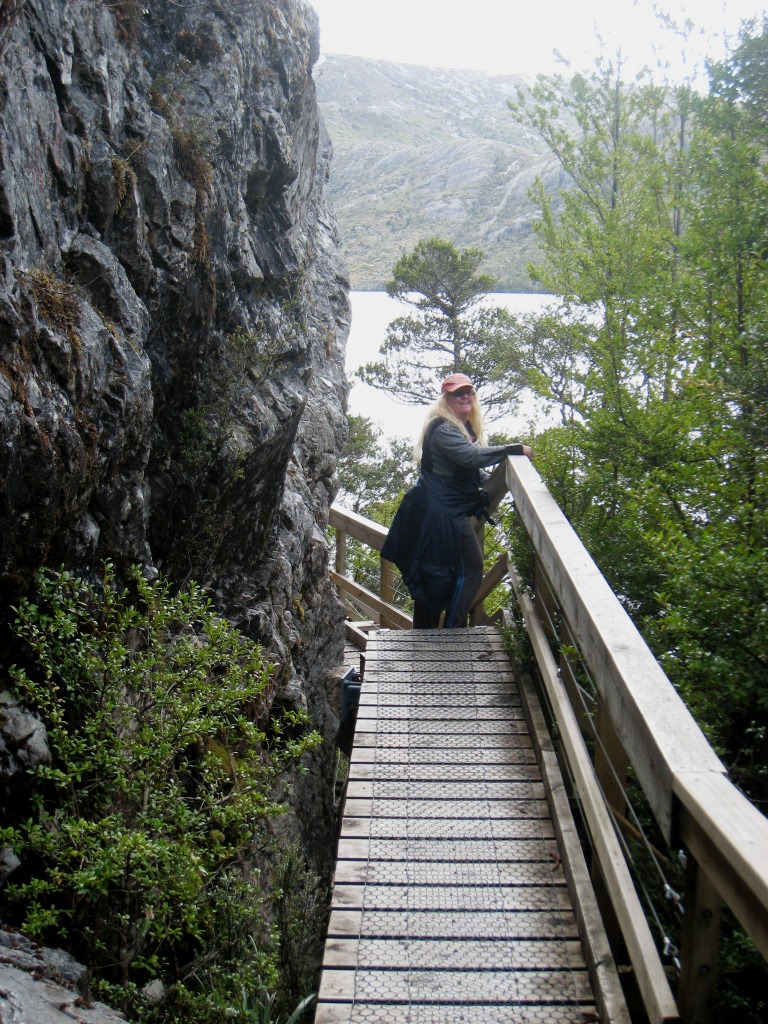
There are also many walks which start at Dove Lake. You can go up onto the peaks if you are energetic and have lots of time but we decided to do the walk around the lake which is 6.5 kilometres. It is a lovely walk with some really scenic vistas across the lake and a variety of unusual flora. Most of the walk is on boardwalks but the last kilometre or so is fairly rough and hilly. It took us about 2.5 hours but we didn’t rush. There is a photo opportunity around every bend so it is great to dawdle and take it all in. As you can see we just couldn't help ourselves!


After Cradle Mountain we went east and into the Mersey Valley to Lake Parangana where we found another lovely campsite beside the lake. This was a great spot to take in the Walls of Jerusalem. Our plan to walk into the western face was dashed when we discovered it was an 8 hour return trip. It was really interesting on the way to the track though to see a purpose-built slalom kayaking course set up beside a lovely little camp beside the river between Lake Rowallan and Lake Parangana.

We crossed the River Forth along the way.

 
The view from our van at Lake Parangana.

 
Mersey valley stream on the road to the Walls of Jerusalem track.
There was also a group of kids learning to abseil off a sheer rock right beside the road, so this area is certainly well used.

 
We also took the drive up to the Devil’s Gullet, a spectacular lookout which sits out over the cliffs which gives you a great view of the Walls of Jerusalem. The wind really howls through this gorge and it was really something standing there out over the edge of the gorge. It was pretty scary too.


Next day we continued east thinking we might stay somewhere else along the Tiers but we had probably been spoilt by the lakeside camping and decided to continue on to the Tamar area and visit Mitch.