Friday, 21 February 2014

YELLOWSTONE NATIONAL PARK


When we first decided to come back over here we hadn’t really intended to go as far as Yellowstone but boy are we glad we made the effort. Our morning began with suiting up. The snowmobile hire group provide all the gear you need for $15 including suit, shoes, helmet etc. so it was good not to have had to go and spend lots of money on gear we might never need again. Next was the briefing with Gaylon, our guide from Texas. He explained how the machines worked and what to expect and it turned out he did a good job as we all got back in one piece – although one of the girls had a minor mishap when she ran off the road.


John and I were both rather excited as we headed out of West Yellowstone and into the west entrance to the park. We made a brief stop at the park entrance for photos and Gaylon to show all our park passes – these cost an additional $35 per couple. We had bought an annual pass in 2008 for about $100 which is more economical if you are here for an extended time and intend to visit 3 or more National Parks. Entry to State Parks is not covered by this one though so you have to pay for entry to them separately.


In winter, most of the roads in Yellowstone are closed, but they do keep a few open on the northern and western sides of the park and only licensed operators are allowed to use them and they must stay on the roads. However, outside the park in Idaho and Montana there are miles of trails both groomed and ungroomed, which can be used by the public for snowmobiling and Nordic skiing etc.


The first leg of our trip followed the Madison River and it wasn’t long before Gaylon stopped for us to see a coyote stalking a bobcat would you believe. The bobcat was up in a pine tree and the coyote was sitting at the foot of the tree just waiting and hoping Mr Bobcat would come down. It was a real hoot to see them both at one spot. We continued along the Madison and it wasn’t long until we spotted some elk nestled down in the snow beside the river, getting out of the wind and enjoying the intermittent sunshine.

A little further along, we encountered our first buffalo and we were stoked to see them quite close to the road but on the other side of the river.
The tiny little black dot you can see on the opposite bank right at the top left of the picture is a coyote we spotted.


After a brief comfort stop, where we caught up with one of the many snow buses which frequent the park, we continued to Madison Junction where the Madison meets the Gibben River.
 
Here we turned south and followed the Firehole River through some quite spectacular gorge country. Highlight of this leg of the journey was Firehole Falls, although the whole of the gorge is really impressive.
Firehole River
 

Firehole Falls

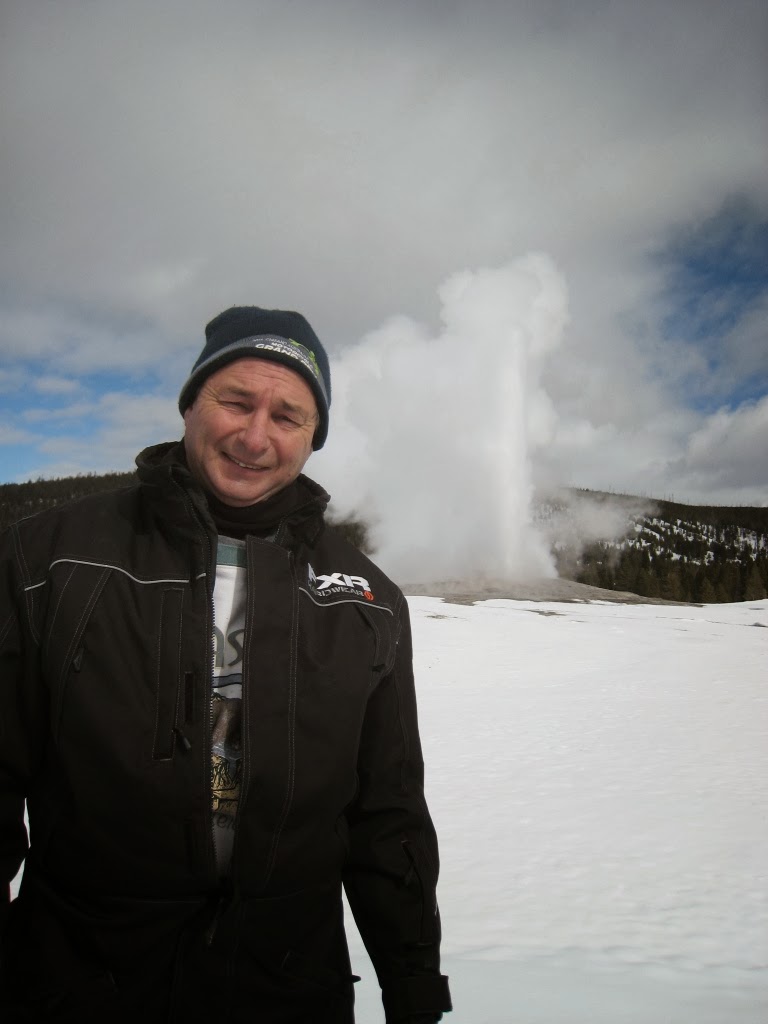
Next it was full on to the Upper Geyser Basin and Old Faithful so we would get there on time to see the next eruption of the geyser. In 2008 John and I had just ridden in when it went up so we had only seen it from a distance. We didn’t want to hang around for another 90 minutes so we missed out then. It certainly was a thrill to see it this time.
Old Faithful at ease.

Then up it goes!

 
We then had a nice lunch at the local café before heading back the way we had come as this was as far as the road was open.

One of the more vintage style snow buses.

This is one of the older buildings at the Upper Geyser Basin.
Looks really interesting but appeared to be all closed up.

Of course you have to expect to share a place as awesome as Yellowstone.
We passed back through the Midway Geyser Basin where we saw lots more bison taking advantage of the warmth provided by the hot springs etc.


Even the Canada geese like the thermal areas.
We took our time and visited a diverse thermal spot in the Lower Geyser Basin which has several different volcanic features as explained to us by Gaylon as we went. Here we viewed the four types of hydrothermal features: geysers, hot springs, mud pots, and fumaroles. It was quite awe-inspiring to learn of the size and potential power of the volcanic caldera which forms Yellowstone. The most striking feature for me here was Silex Spring which is a beautiful turquoise thermal pool of surrounded by various colours formed by different mineral interactions. The sun wasn’t out while we were there so our photos didn’t do it justice but there are lots of photos available which show its true beauty. You can learn more about this area at: http://www.everytrail.com/guide/fountain-paint-pot-yellowstone-national-park

 
Silex Spring


Yes that's bison poo under that snow. They frequent this area as well.
 
 
They even named a pool after Chris' family - (Leather is her maiden name)


I was pleased to see a few bird species in the park including Canada geese, mallards, golden eyed ducks, a mute swan and a magnificent bald eagle.
Everywhere you look there are beautiful scenes to photograph.


Further on we encountered more bison, coyotes and elk wandering beside the river. Gaylon explained that there are some people who claim the tourism activities in the park are detrimental to the wildlife but from what we saw, the animals couldn’t have cared less about us. They just went about their business as though we weren’t there.


This was especially evident when, at the same place where we had seen him on the way out, we were treated to a wonderful sighting of Mr Bobcat, who had obviously outlasted the coyote, and was lounging on a log beside the river, before getting up and sauntering along the bank in full view of at least 100 tourists who were watching from across the river.
 
What a wonderful way to end a wonderful day!!!!! All up we had covered about 60 miles/100km but with such beauty around us we wouldn’t have had a clue how far we had gone.


If you want to learn more about this amazing place called Yellowstone National Park go to:

http://www.nps.gov/yell/index.htm

Monday, 17 February 2014

IDAHO


We crossed into Idaho just west of Homedale and picked up the I84 near Caldwell. It was a bit tricky navigating our way to the hotel we had chosen – life is a lot easier if you know which Exit to jump off. Anyway we found Inn America just near the airport in Boise and we would recommend it as very well priced with all the amenities needed. Boise is the capital of Idaho with lots of services, shopping etc so we had decided to stock up here before continuing on to Yellowstone. We were looking at taking a wildlife adventure package out of Mammoth Hot Springs so we thought we might need some more suitable outdoor clothing etc. However after several phone calls we discovered that the Mammoth Hot Springs tours were totally booked out. Next best option was to go to West Yellowstone, book into a hotel and pick up a guided package from there.

Our mate Steve had spoken about Cabela’s, a huge outdoor store similar to Anaconda in Australia, but on a much larger scale, so we decided that a visit to Cabela’s was a must. We found the store on our first afternoon and had a fantastic time exploring. The range of “camo” gear available is amazing. You can buy everything from undies and bed linen to furniture in the camo prints and the wildlife displays in the store were something to see by themselves. Anyway we made two visits to Cabela’s and really enjoyed ourselves.

The "camo" look is all the rage!!

This would look great beside the Bushtracker!


And what about this little beauty for those off-road ventures?


Imagine shooting deer from the porch, sitting on this in your camo jocks!

 
The wildlife displays included two large aquariums full of catfish, trout etc.


This bar came complete with waitress on roller skates.
After two nights in Boise we headed east on the 21. Our plan was to visit Idaho City, an old mining town and then continue up the 21 to Stanley. However, signs at the start of the 21 informed us that the Highway was closed near Bennet Summit due to the high risk of avalanches. We decided to go on up to Idaho City then come back down and take the 20 across to Hailey and up through Sun Valley, site of North America’s first commercial ski resort. Idaho City was very quiet, obviously due to the road closure and we were a day early for the great Idaho City chilli cookoff. Darn!!!
Idaho City
 
The main street

On the way to Idaho City we passed the Arrow Rock Reservoir where the seasonal water levels could be clearly seen up the sides of the valley. They were obviously very low at the moment. There were boat ramps which finished 100 metres up  the embankment from the water. The snow melt must provide a huge volume of water here.
Highway 20 across to the 75 Junction is extremely boring - just non-stop flat treeless plains. It gets more interesting again though when you turn off to Hailey. We decided to stop in a lovely little place called Bellevue, just south of Hailey and pulled into the High Country Motel. They were in the middle of renovating but the manager was really obliging and hustled us up a room which had just been vacated. While we waited for the room to be made up he recommended that we might like to visit the Ice Caves, just to the south so we headed down there for a look. Unfortunately, nobody had told him that they were closed for the winter. There wasn’t even a sign at the highway and we didn’t discover the closure until we had driven all the way in there. I guessed that the fact that it was run by the local indians might have had something to do with it. Anyway we spent half an hour chatting to an old guy at the trading post across the road and having a look around his shop.

This quirky green dinosaur is outside the Ice Caves.


Lava fields on the way to the Ice Caves.


The creek behind the motel was lined with aspen trees. They are common to the east of the Cascades and are very different from the pines and firs with their white trunks. From the way they grow though, I could imagine them becoming a bit like the poplars at home - a bit of a pest.
That night, while at Mahoney’s, the local pub for dinner, we had drinks bought for us and discovered they were from the guy who was doing the renovating at the motel. He and his wife were also having tea there and we ended up having a lovely evening talking (and drinking too much) with them. Bill was of Indian origin but had done a lot of travelling in the armed forces so he and his lovely with Roseann were really interesting to talk to. We ended up having breakfast with them in Hailey as well at a quaint little diner called Shorty’s.
Inside Shorty's Diner.
 
John was impressed by this "must have" auto accessory. If you live out of town where the snow ploughs aren't maintaining the roads, this is the only way to get through the snow.

Then it was off on a lovely drive north through Sun Valley and up over Galena Summit to Stanley. The snow grew deeper as we drove north.
 
 
Note the top of the fence posts at the left.
 
Closed for the winter.
 

These fences are built entirely of timber using a fishbone pattern which looks like a zig zag if looked at from above.

We saw lots of cross-country skiers with their dogs enjoying the snow between Sun Valley and Stanley, where there are lots of snow parks with ski and snowmobile trails running adjacent to the road.

We also saw lots of ranch houses but no cattle.
They must go elsewhere for the winter.

At Stanley we turned right and followed the Salmon River as it wound through steep canyons to just south of Challis. This was a very spectacular part of the journey as the whole area is mostly bare of vegetation. In some places thee mountains had a greenish tinge, suggesting there might be a lot of copper in the soil. 
13 miles east of Stanley are the Sunbeam Hot Springs, where steam and water just appear out of the ground with no snow around the spring area.


The hot water runs under the road and into the Salmon River below.
Obviously it is a popular swimming spot in the summer.


Salmon River, Idaho

Our first sighting off deer beside the road.


The Salmon River Mountains


Parts of the river were frozen over.

 
At the Land of the Yankee Fork, we turned south again onto the 93 down to Arco. Again, the scenery was different, with the road following the foothills of the Lost River Range past Borah Peak, Idaho’s highest at 12 662 feet. Unfortunately, because of low cloud we didn’t get a peek at the peak.


One of the highlights along this route was a stopover at Mackay Reservoir to take a look at the locals who were ice-fishing out on the lake. It was quite a sight with them all standing or sitting around, tinny in one hand and fishing rod in the other, with their lines dropped down through holes in the ice which they had drilled with what looked like post-hole augers. They were only catching very small trout which we guess they smoke but they were quite happy, with baby tucked snugly in the warm tent they had erected.


Arco was originally known as Root Hog and the original town site was five miles (8 km) south at the junction of two stagecoach lines. It was the first community in the world ever to be lit by electricity generated by nuclear power. This occurred on July 17, 1955, powered by Argonne National Laboratory’s BORAX-III reactor at the nearby National Reactor Testing Station (NRTS).  NRTS made further history on January 3, 1961, when the SL-1 reactor melted down, causing three deaths. It was the world's first (and the U.S.' only) fatal reactor accident. In town, the most striking physical feature is Number Hill, a rocky hill with numbers painted all over it. Butte County High School has a tradition of each class since 1920 painting its graduation year on the face of hill.

 
Well, the history should have been an indication to us that Arco is still a bit of a disaster. The town is obviously going through very hard times, but we didn’t see this as an excuse for the disgusting state of the motel we picked. There were 4 motels in the town and none had more than one car parked outside. Never stay at the DK Motel in Arco. The rooms had a musty smell and everything was in need of repair. The first room he gave us had a water pipe spurting water everywhere. We should have changed our minds then but because the nearest town on our route where we figured there would be another motel was Rexburg, 86 miles away, we persevered. All I can say is we were glad to get out of there next morning without some dreaded disease.

We had asked “Homer” at the motel if the Craters of the Moon National Monument was worth seeing and he assured us it was fantastic so we headed out there first thing next morning. It was actually about 40 miles out of our way so we weren’t very impressed to discover that only the visitors centre was open. The lady there was very nice though and the centre provided lots of information through displays and videos so it wasn’t a wasted journey and we would recommend a visit in the summer. Web site is at http://www.nps.gov/crmo/index.htm. After this and the ice cave debacle it is obvious that many of the “locals” don’t know much about what goes on around them.

The drive across from Arco to Rexburg is pretty ordinary, but then we turned north again on the 20 toward West Yellowstone in Wyoming. Along this route, the forecast strong winds caught up with us and wherever the road went through flat unwooded country, it was almost whiteout conditions, With snow being blown across the road and a steady drizzle of rain coming down, driving was a challenge, especially when there were still those drivers who were in such a hurry that they HAD to pass.
 
It got even more interesting as we gained height and started climbing up to Targhee Pass. Several semis were stopped to fit chains, and there was an old guy towing a caravan would you believe. He was having a terrible time. He didn’t seem to have chains on and his truck mustn’t have had 4 wheel drive, as his back wheels were just spinning on the icy road. Hopefully the poor bugger got over safely, but we thought he was very foolish to be even attempting it. Anyway, as if on cue, the sun came out as we crossed the border into Montana.